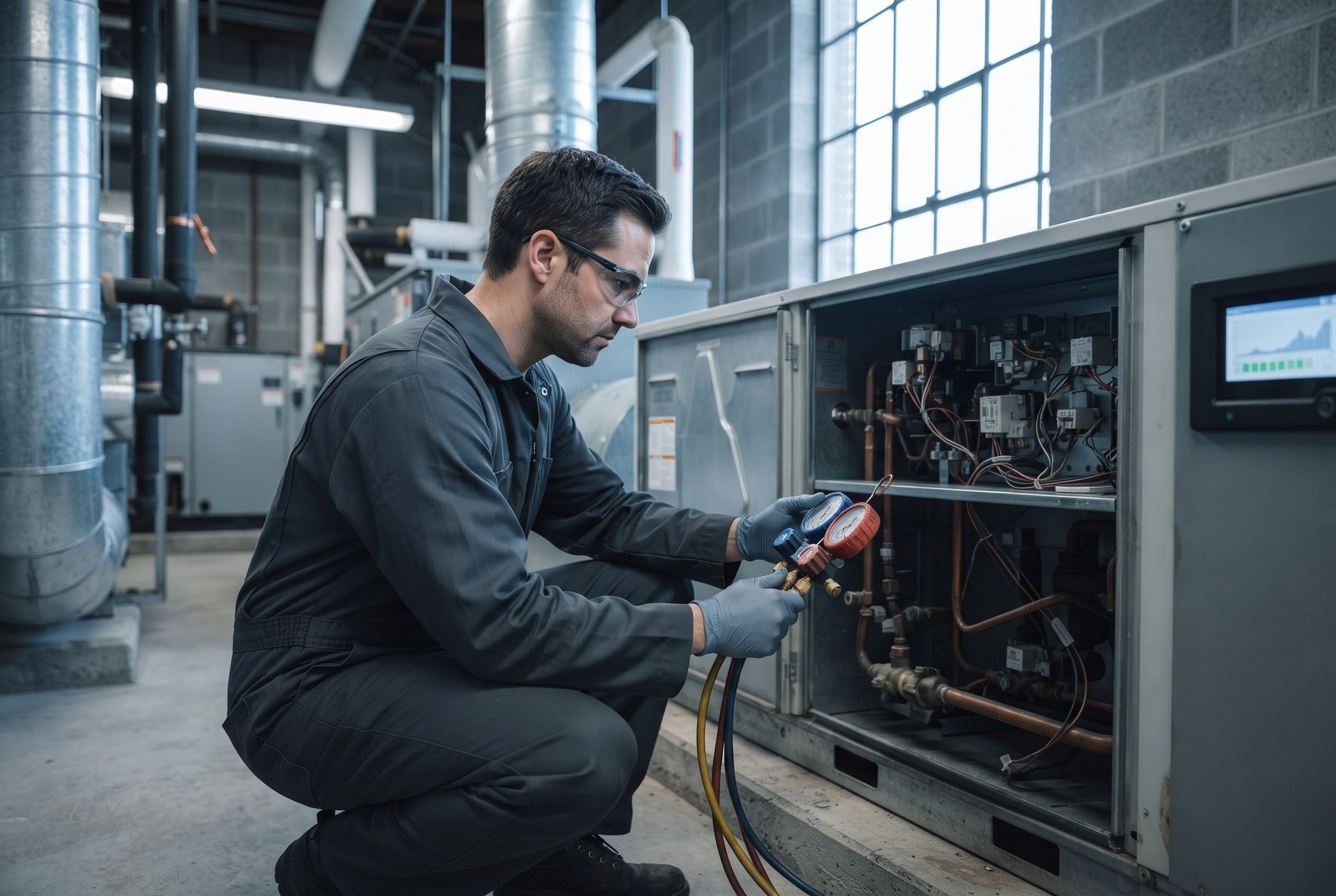
Marketing & Growth Systems Built for HVAC Companies
HVAC runs on urgency and seasonality that no generic home-services plan accounts for. This is how we help HVAC companies turn emergency searches, Google Business Profile visibility, and after-hours calls into booked jobs — and booked jobs into recurring revenue.
Industry Overview
HVAC Is a High-Urgency, High-Seasonality Business
Heating and cooling isn't a discretionary purchase — when a furnace fails in January or an AC unit dies in a July heat wave, the homeowner needs someone today, not someone who sends the best-looking quote next week. That single fact shapes almost everything about how HVAC companies should market and operate differently from other home service trades.
No heat or no cooling — they search
They call whoever answers first
Answered, or called back within minutes
Job logged and assigned
How an emergency call becomes a booked job
Revenue for most HVAC companies is a mix of three very different jobs: emergency repairs (highest urgency, often highest margin per hour), scheduled maintenance and tune-ups (lower urgency, higher predictability), and system replacements (the largest single-ticket jobs, usually decided over days rather than minutes). Inside our Growth Score™ engine, we model typical HVAC job values in the $500–$8,000 range — a spread wide enough that a company's marketing and follow-up systems need to handle a $150 diagnostic call and a $7,000 system replacement with equally fast, equally professional response.
Demand itself is far from steady. It spikes hard around two windows a year — the first real cold snap and the first real heat wave — and stays comparatively quiet in the shoulder seasons between them. Companies that market at a constant pace all year, rather than building around those two spikes, consistently underperform companies that concentrate effort in the weeks just before each one hits.
Growth Challenges
Where HVAC Companies Actually Lose Revenue
None of these are marketing-budget problems first. They're systems problems that marketing spend can't fix on its own.
Revenue Leaks
Missed after-hours calls, one-time service customers who never become maintenance-plan members, and slow follow-up on estimate requests that quietly go to a faster-responding competitor. Each is invisible on its own; together they're usually the largest source of lost revenue.
Competitive Landscape
HVAC is a crowded, high-intensity local market. Homeowners rarely differentiate between similarly-priced companies on service quality alone — they choose based on who looks most credible and available right now, which makes Google Business Profile strength and review velocity a direct competitive lever.
Operational Bottlenecks
Dispatch and scheduling that rely on manual coordination struggle the moment call volume spikes during a seasonal surge — exactly when the business needs to convert the most leads with the least friction.
Marketing Challenges
Flat, always-on marketing that ignores the shoulder-season windows before each demand spike. By the time the first cold snap hits, paid search costs are already elevated and every competitor is running the same emergency-service messaging.
Technology Challenges
No automated first-response for after-hours calls, no systematic review-request workflow tied to completed jobs, and CRM systems (if any) that track leads but not maintenance-plan renewal dates.
Trust & Credibility Gaps
Licensing, insurance, and background-check documentation that isn't clearly surfaced — which matters for homeowner trust and is frequently the reason Local Service Ads applications stall or get rejected.
KPIs to Track
The Numbers That Actually Move HVAC Revenue
< 5 min
Target response time for a "no heat" / "no AC" emergency call
24/7
After-hours coverage window homeowners expect from HVAC
2×/yr
Recommended seasonal campaign pushes — furnace season + AC season
Steady
Review velocity homeowners and Google both read as "active business"
› Speed-to-lead / first-response time, split by emergency vs. scheduled
› Booked-job close rate on emergency vs. estimate calls
› Average ticket value across repair, tune-up, and replacement jobs
› Maintenance-plan attach rate and annual renewal rate
› Review velocity (new reviews per month, not just total count)
› Google Business Profile calls and direction requests
› Cost per booked job, by season and by channel
› Emergency vs. scheduled job mix, tracked seasonally
Growth Opportunities
The Highest-Leverage Moves for HVAC Companies
Google Business Profile & Local Service Ads readiness — categories, licensing verification, and emergency-specific attributes built for how HVAC is actually searched. See the LSA-ready GBP checklist.
After-hours speed-to-lead automation — an immediate, automated first response for emergency calls, detailed in our emergency response guide.
Maintenance-plan conversion at the point of service — turning one-time repairs into recurring revenue, covered in this playbook.
A seasonal campaign calendar built around furnace season and AC season shoulder windows, not flat year-round spend — see the seasonal marketing calendar.
Systematic review generation tied to the moment a job is completed, not an occasional manual ask — see the review generation system.
Service area page buildout for every town genuinely served, following the same principles in our service area pages guide.
How Alliance Optima Helps
A Growth System Built Around HVAC's Actual Priorities
HVAC is one of the industry profiles built directly into our Growth Score™ engine — not a generic "home services" bucket. That means the assessment automatically weighs Google Business Profile completeness, review velocity, and after-hours automation more heavily for an HVAC business than it would for a lower-urgency local business, because those are the three areas where HVAC companies most consistently win or lose revenue.
After your free Growth Score™ assessment, we walk through the results together in a Growth Strategy Session™ — a focused conversation about which of the opportunities above will move revenue fastest for your specific business, not a generic sales pitch.
Find Out Your Growth Score™
Get a free, AI-powered assessment of your online presence in under 60 seconds.
A 60-second assessment of your website, Google presence, lead capture, and automation.
2
Growth Strategy Session™
A free session reviewing your report and identifying your highest-impact HVAC-specific moves.
3
Prioritized Blueprint
A sequenced plan across GBP/LSA readiness, speed-to-lead automation, and review generation.
4
Seasonal Optimization
Ongoing adjustments timed to furnace season and AC season, not a one-time setup.
What You Get
Deliverables
✓ Your Growth Score™ Report (downloadable PDF)
✓ A live Growth Strategy Session™ walkthrough
✓ A prioritized growth blueprint specific to HVAC
✓ Google Business Profile & LSA-readiness recommendations
✓ Speed-to-lead and after-hours automation plan
✓ Review generation and maintenance-plan strategy
Frequently Asked Questions
Does Alliance Optima work specifically with HVAC companies?+
Yes. HVAC is one of the industry profiles built directly into our Growth Score™ engine, which weighs Google Business Profile strength, review velocity, and after-hours automation more heavily for HVAC than for lower-urgency industries — because that is where HVAC companies actually win or lose jobs.
What makes HVAC marketing different from marketing for other home service businesses?+
Two things: extreme seasonality (demand spikes hard around the first cold snap and first heat wave) and extreme urgency (a homeowner with no heat calls whoever answers first, not whoever has the best website). A generic home-services marketing plan misses both.
How long does it take to see results from an HVAC growth plan?+
It depends on what is broken. Speed-to-lead and Google Business Profile fixes can show up in call volume within weeks. Review velocity and seasonal campaign compounding are built over a full season or two, not overnight.
Do you help with Google Local Service Ads (LSA) for HVAC?+
We help HVAC companies get their Google Business Profile, licensing, and category structure into the shape LSA approval requires, and build the review and response systems that make LSA leads convert once they start arriving. See our guide to the LSA-ready Google Business Profile checklist for the full process.
What is the Growth Score™ assessment and how does it apply to HVAC?+
The Growth Score™ is a free, AI-powered assessment of your website, Google presence, lead capture, and automation, delivered in minutes. For HVAC companies specifically, it automatically prioritizes Google Business Profile completeness, review velocity, and after-hours lead-response automation — the three areas our HVAC industry profile flags as highest-impact.
Do you build maintenance-plan or membership programs, or just marketing?+
Both are part of the same system for us. A maintenance-plan program that converts one-time service calls into recurring revenue depends on the same CRM and follow-up automation that powers speed-to-lead — we treat acquisition and retention as one connected plan, not two separate projects.
Go Deeper
HVAC Growth Guides
Every guide below plugs into this playbook — start wherever your business needs the most help right now.
We use cookies to understand how visitors use our site (Google Analytics and Microsoft Clarity) so we can improve it. You can accept or decline analytics cookies. Essential cookies are always on. Privacy & Cookies